Το ίδιο σκληροί είναι και οι φανατικοί Άραβες ή και χειρότεροι από τους Ισραηλινούς όταν βάζουν τα παιδιά να μεγαλώσουν σε στρατόπεδα για να γίνουν αργότερα κινούμενες βόμβες. Αν διαβάσεις καλά ιστορία θα μπορείς να κατακρίνεις πιο εύκολα. Δε λέω ότι δεν υπάρχουν ισραηλινοί εθνικιστές. Υπάρχουν όμως πολλοί περισσότεροι άραβες εθνικιστές. Και αυτό κάποιοι το ξεχνάνε στην Ελλάδα. Κάτι που ευτυχώς δε γίνεται στο εξωτερικό.
Και να ξέρεις ότι ο αντιαμερικανισμός και ο αντισημιτισμός είναι η νέα μορφή του εθνικισμού
https://en.wikipedia.org/wiki/Antisemitism
Δες λοιπόν τη συνεχή βία και διωγμούς τους από την Αρχαιότητα εως σήμερα και για το για ποιούς λόγους ήταν αναγκασμένοι από τις διάφορες κυβερνήσεις κρατών να εξασκούν μόνο συγκεκριμένα επαγγέλατα που τους επιβλήθηκαν
Ancient world
Examples of antipathy to
Jews and
Judaism during
ancient times are abundant. Statements exhibiting prejudice towards Jews and their religion can be found in the works of many pagan Greek and Roman writers.
[24] There are examples of
Greek rulers desecrating the
Temple and banning Jewish religious practices, such as circumcision,
Shabbat observance, study of Jewish religious books, etc. Examples may also be found in anti-Jewish riots in
Alexandria in the 3rd century BCE.
Philo of Alexandria described an attack on Jews in Alexandria in 38 CE in which thousands of Jews died.
The Jewish diaspora on the Nile island Elephantine, which was founded by mercenaries, experienced the destruction of its temple in 410 BCE.
[25]
Relationships between the Jewish people and the occupying
Roman Empire were at first antagonistic and resulted in
several rebellions. According to
Suetonius, the emperor
Tiberius expelled from Rome, Jews who had gone to live there. The 18th century
English historian
Edward Gibbon identified a more tolerant period beginning in about 160 CE.
According to
James Carroll, "Jews accounted for 10% of the total population of the
Roman Empire. By that ratio, if other factors such as
pogroms and
conversions had not intervened, there would be 200 million Jews in the world today, instead of something like 13 million."
[26][27]
[edit] Persecutions in the Middle Ages
Main article:
Jews in the Middle Ages
Part of
a series of articles on
Jews and Judaism Who is a Jew? · Etymology · Culture
v • d • e
From the 9th century CE, the
medieval Islamic world classified Jews (and Christians) as
dhimmi, and were allowed to practice their religion more freely than they could do in
medieval Christian Europe. Under
Islamic rule, there was a
Golden age of Jewish culture in Spain that lasted until at least the 11th century,
[28] when several Muslim pogroms against Jews took place in the
Iberian Peninsula; those that occurred in
Córdoba in 1011 and in
Granada in 1066.
[29][30][31] Several decrees ordering the destruction of synagogues were also enacted in
Egypt,
Syria,
Iraq and
Yemen from the 11th century. Despite the
Qur'an's prohibition, Jews were also forced to convert to Islam or face death in some parts of Yemen, Morocco and
Baghdad several times between the 12th and 18th centuries.
[32] The
Almohads, who had taken control of the
Almoravids'
Maghribi and Andalusian territories by 1147,
[33] were far more fundamentalist in outlook, and they treated the
dhimmis harshly. Faced with the choice of either death or conversion, many Jews and Christians emigrated.
[34][35][36] Some, such as the family of
Maimonides, fled east to more tolerant Muslim lands,
[34] while some others went northward to settle in the growing Christian kingdoms, where Jews were increasingly forced to convert to Christianity from the 13th century.
[37][38]
During the
Middle Ages in Europe there was persecution against Jews in many places, with
blood libels, expulsions,
forced conversions and
massacres. A main justification of prejudice against Jews in Europe was religious. The persecution hit its first peak during the
Crusades. In the
First Crusade (1096) flourishing communities on the Rhine and the Danube were destroyed; see
German Crusade, 1096. In the
Second Crusade (1147) the Jews in Germany were subject to several massacres. The Jews were also subjected to attacks by the
Shepherds' Crusades of 1251 and 1320. The Crusades were followed by expulsions, including in, 1290, the banishing of all English Jews; in 1396, 100,000 Jews were expelled from France; and, in 1421 thousands were expelled from Austria. Many of the expelled Jews fled to Poland.
[39]
As the
Black Death epidemics devastated Europe in the mid-14th century, annihilating more than half of the population, Jews were used as
scapegoats. Rumors spread that they caused the disease by deliberately
poisoning wells. Hundreds of Jewish communities were destroyed by violence. Although
Pope Clement VI tried to protect them by the July 6, 1348,
papal bull and an additional bull in 1348, several months later, 900 Jews were burnt alive in
Strasbourg, where the plague hadn't yet affected the city.
[40]
[edit] Seventeenth century
During the mid-to-late 17th century the
Polish-Lithuanian Commonwealth was devastated by several conflicts, in which the Commonwealth lost over a third of its population (over 3 million people), and Jewish losses were counted in hundreds of thousands. First, the
Chmielnicki Uprising when
Bohdan Khmelnytsky's
Cossacks massacred tens of thousands of
Jews in the eastern and southern areas he controlled (today's
Ukraine). The precise number of dead may never be known, but the decrease of the Jewish population during that period is estimated at 100,000 to 200,000, which also includes emigration, deaths from diseases and
jasyr (captivity in the
Ottoman Empire).
[41][42]
[edit] Eighteenth century
This section
does not cite any references or sources. Please help
improve this article by adding citations to
reliable sources. Unsourced material may be
challenged and
removed.
(June 2007)
In 1744,
Frederick II of Prussia limited the number of Jews allowed to live in
Breslau to only ten so-called "protected" Jewish families and encouraged a similar practice in other
Prussian cities. In 1750 he issued the
Revidiertes General Privilegium und Reglement vor die Judenschaft: the "protected" Jews had an alternative to "either abstain from marriage or leave Berlin" (quoting
Simon Dubnow). In the same year, Archduchess of
Austria Maria Theresa ordered Jews out of
Bohemia but soon reversed her position, on the condition that Jews pay for their readmission every ten years. This
extortion was known as
malke-geld (queen's money). In 1752 she introduced the law limiting each Jewish family to one son. In 1782,
Joseph II abolished most of these persecution practices in his
Toleranzpatent, on the condition that
Yiddish and
Hebrew were eliminated from public records and that judicial autonomy was annulled.
Moses Mendelssohn wrote that "Such a tolerance... is even more dangerous play in tolerance than open persecution."
In 1772, the empress of Russia
Catherine II forced the Jews of the
Pale of Settlement to stay in their
shtetls and forbade them from returning to the towns that they occupied before the
partition of Poland.
[43]
[edit] Nineteenth century
Historian
Martin Gilbert writes that it was in the 19th century that the position of Jews worsened in Muslim countries.
Benny Morris writes that one symbol of Jewish degradation was the phenomenon of stone-throwing at Jews by Muslim children. Morris quotes a 19th century traveler: "I have seen a little fellow of six years old, with a troop of fat toddlers of only three and four, teaching [them] to throw stones at a Jew, and one little urchin would, with the greatest coolness, waddle up to the man and literally spit upon his Jewish
gaberdine. To all this the Jew is obliged to submit; it would be more than his life was worth to offer to strike a Mahommedan."
[44]
In 1850 the
German composer
Richard Wagner published
Das Judenthum in der Musik ("Jewishness in Music") under a
pseudonym in the
Neue Zeitschrift für Musik. The essay began as an attack on Jewish composers, particularly Wagner's contemporaries (and rivals)
Felix Mendelssohn and
Giacomo Meyerbeer, but expanded to accuse Jews of being a harmful and alien element in
German culture.
The
Dreyfus Affair highlights anti-semitism during the 19th Century. Alfred Dreyfus, a Jewish artillery captain in the French army, was accused in 1894 of passing secrets to the Germans. As a result of these charges, Dreyfus was convicted and sentenced to life imprisonment at Devil's Island. The actual spy Marie Charles Esterhazy was acquitted. The event caused great uproar among the French and everyone chose a side regarding whether Dreyfus was actually guilty or not. Émile Zola accused the army of polluting the French Justice system. However, general consensus held that Dreyfus was guilty: eighty percent of the press in France condemned Dreyfus. This attitude among the majority of the French population reveals the underlying anti-semitism of the time period.
[45]
Adolf Stoecker (1835-1909), the Lutheran court chaplain to Kaiser Wilhelm I, founded in 1878 an antisemitic, antiliberal political party called The
Christian Social Party (Germany). However, this party did not attract as many votes as the Nazi party, which flourished in part because of The Great Depression which hit Germany especially hard during the early 1930s.
[46]
[edit] Twentieth century
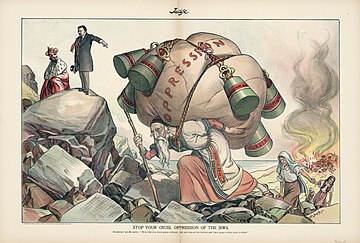
Russian Tsar-Stop your cruel oppression of the Jews! (1904)
In the first half of the twentieth century, in the USA, Jews were discriminated against in employment, access to residential and resort areas, membership in clubs and organizations, and in tightened quotas on Jewish enrollment and teaching positions in colleges and universities. The
Leo Frank lynching by a mob of prominent citizens in
Marietta,
Georgia in 1915 turned the spotlight on antisemitism in the United States. The case was also used to build support for the renewal of the
Ku Klux Klan which had been inactive since 1870.
In the beginning of 20th century, the
Beilis Trial in
Russia represented incidents of blood libel in Europe. Allegations of Jews killing Christians were used as justification for killing of Jews by Christians.
Antisemitism in America reached its peak during the interwar period. The pioneer automobile manufacturer
Henry Ford propagated antisemitic ideas in his newspaper
The Dearborn Independent. The radio speeches of
Father Coughlin in the late 1930s attacked
Franklin D. Roosevelt's
New Deal and promoted the notion of a Jewish financial conspiracy. Such views were also shared by some prominent politicians;
Louis T. McFadden, Chairman of the
United States House Committee on Banking and Currency, blamed Jews for president Roosevelt's decision to abandon the
gold standard, and claimed that "in the United States today, the Gentiles have the slips of paper while the Jews have the lawful money."
[47]
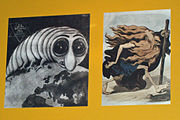
Two common Anti-semitic depictions of Jews during Nazi Germany: on the left is the Capitalist/Communist global parasite depiction; on the right is the
Wandering Jew.
In the 1940s the
aviator Charles Lindbergh and many prominent Americans led The
America First Committee in opposing any involvement in the war against Fascism. During his July 1936 visit he wrote letters saying that there was “more intelligent leadership in Germany than is generally recognized.”
The
German American Bund held parades in
New York City during the late 1930s where
Nazi uniforms were worn and flags featuring
swastikas were raised alongside American flags. The US House Committee on Un-American Activities (HUAC) was very active in denying the Bund's ability to operate. With the start of US involvement in
World War II most of the Bund's members were placed in
internment camps, and some were deported at the end of the war.
Sometimes, during race riots, as in
Detroit in 1943, Jewish businesses were targeted for looting and burning.
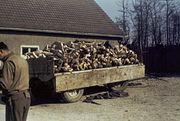
An American soldier stands near a wagon piled high with corpses outside the crematorium in the newly liberated
Buchenwald concentration camp
In Nazi occupied Europe, oppressive discrimination of the Jews and denial of basic civil rights, escalated into a campaign of mass murder, culminating, from 1941 to 1945, in
genocide: the
Holocaust.
[48] Eleven million Jews were targeted for extermination by the Nazis, and some six million were eventually killed.
[48][49][50] This is seen by many as the culmination of generations of antisemitism in Europe.
Antisemitism was commonly used as an instrument for personal conflicts in
Soviet Russia, starting from conflict between
Stalin and
Trotsky and continuing through numerous conspiracy theories spread by official propaganda. Antisemitism in the
USSR reached new heights after 1948 during the campaign against the
"rootless cosmopolitan" (euphemism for
"Jew") in which numerous Yiddish-writing poets, writers, painters and sculptors were killed or arrested.
[51][52] This culminated in the so-called
Doctors' Plot. Similar anti-Jewish propaganda in Poland resulted in the flight of the Polish Jewish survivors out of the country.
[52]
After the war, the
Kielce pogrom and "
March 1968 events" in communist
Poland represented further incidents of antisemitism in Europe. The common theme behind the
anti-Jewish violence in postwar Poland were
blood libel rumours.
[53][54]
The cult of
Simon of Trent was disbanded in 1965 by
Pope Paul VI, and the shrine erected to him was dismantled. He was removed from the calendar, and his future veneration was forbidden, though a handful of extremists still promote the narrative as a fact.

